AI Overview
Chain of responsibility means that everyone who influences a heavy vehicle transport task shares the duty for its safety, not just the driver behind the wheel. On urgent freight that includes the person who set the deadline, packed the crate, loaded the tray and signed for it at the gate. The deadline is the single biggest source of breaches, because a delivery time that can only be met by speeding or skipping a rest break is a scheduling decision, and the law treats it as one.
- If you book, pack, load, schedule or receive urgent freight, you are a party in the chain - the duty is not the driver's alone
- A deadline that can only be met by speeding or by skipping a mandatory rest break is a scheduling breach, not a driver problem
- Load restraint and mass duties start at the sender's dock, before the vehicle moves
- You cannot contract the duty away - a clause in a purchase order does not transfer it to the carrier
- Western Australia has not adopted the Heavy Vehicle National Law, so a Perth run and an interstate run sit under different frameworks
- The fix is almost always information: give dispatch the real weight, the real dimensions and the real deadline before the job is accepted
When an urgent parts run goes wrong, the instinct is to look at the driver. The law does not stop there. Australian heavy vehicle law works on the principle that everyone who influences a transport task carries a share of the duty to make it safe.
That includes the maintenance planner who set the deadline, the warehouse that packed the crate, the person who loaded the tray, and the site that receives the freight at the gate. If your decision could make the run unsafe, you are a party in the chain of responsibility.
This guide explains what that means in practice for the people who book urgent freight to WA mining and industrial sites, where the exposure usually sits, and what to check before you place the job. It is general information about how the duty works, not legal advice.
What Chain of Responsibility Actually Means
Chain of responsibility is the idea that heavy vehicle safety is not the driver's job alone. The people who influence how a transport task is planned, packed, loaded and paid for all have a duty to make sure their decisions do not cause an unsafe outcome on the road.
It exists because most road transport failures are set in motion long before the vehicle leaves. A load that shifts was packed badly. A driver who is fatigued was given a schedule that did not fit inside the legal driving hours.
The duty is a safety duty rather than a paperwork duty. It asks whether you took reasonably practicable steps to prevent the risk, given what you knew and what you controlled. Signing a form does not discharge it.
You cannot contract the duty away
A clause in a purchase order or a supply agreement stating that the carrier is solely responsible for compliance does not move your duty onto them. The duty attaches to what you actually influence, not to what the contract says.
You Are in the Chain the Moment You Book the Run
Most people booking urgent freight assume they are a customer. In heavy vehicle law they are usually a consignor, and often a packer and a loader as well. Those are named roles with their own duties.
| Role | Who this usually is | What the duty covers |
|---|---|---|
| Consignor | The supplier or warehouse sending the freight | Accurate weight and description, realistic timing, freight that is fit to travel |
| Packer | Whoever crates, palletises or wraps the item | Packaging that holds the item stable and can be restrained on a tray |
| Loader | The dock crew or yard hand who puts it on the vehicle | Correct placement, correct mass distribution, restraint that suits the load |
| Scheduler | The planner or buyer who sets the required delivery time | A deadline the run can meet inside legal driving hours and speed limits |
| Consignee or receiver | The site taking delivery | Access, unloading arrangements and not creating pressure to breach on arrival |
Common roles on an urgent freight run and where the duty sits
One person often holds several of these roles at once. A supply officer who picks the part, wraps it, forklifts it onto the tray and tells the carrier it must be on site by first light has just acted as consignor, packer, loader and scheduler.
The Deadline Is Where Most Breaches Start
Urgent freight is defined by its deadline, which is exactly what makes it the risk point. If the only way to meet a stated delivery time is to exceed the speed limit or push past a mandatory rest break, the schedule itself is the breach.
This is not a technicality. A stated time that cannot be met legally puts the driver in the position of choosing between your deadline and the law, and the person who set the time is a party to that.
How to Set a Deadline That Does Not Create Pressure
- Say when the part is actually needed on site, not an artificially early time meant to build in buffer
- Ask the carrier what the realistic arrival window is for that corridor before you commit to it internally
- Accept the answer when a carrier says a time cannot be met legally, rather than calling the next operator until someone agrees
- If the window is genuinely immovable, ask about a two-driver run instead of asking one driver to go faster
- Record the agreed window in writing so the expectation is the same on both sides
Shopping the job around is a documented pattern
If three carriers say a delivery time cannot be met legally and the fourth agrees to it, that agreement does not make the schedule safe. It usually means the fourth carrier intends to make up the time somewhere, and the booking record shows you kept asking until someone said yes.
Load Restraint and Mass Start at Your Dock
Two of the duties that most often come back to the sender are load restraint and mass. Both are decided at the point of packing and loading, not on the road.
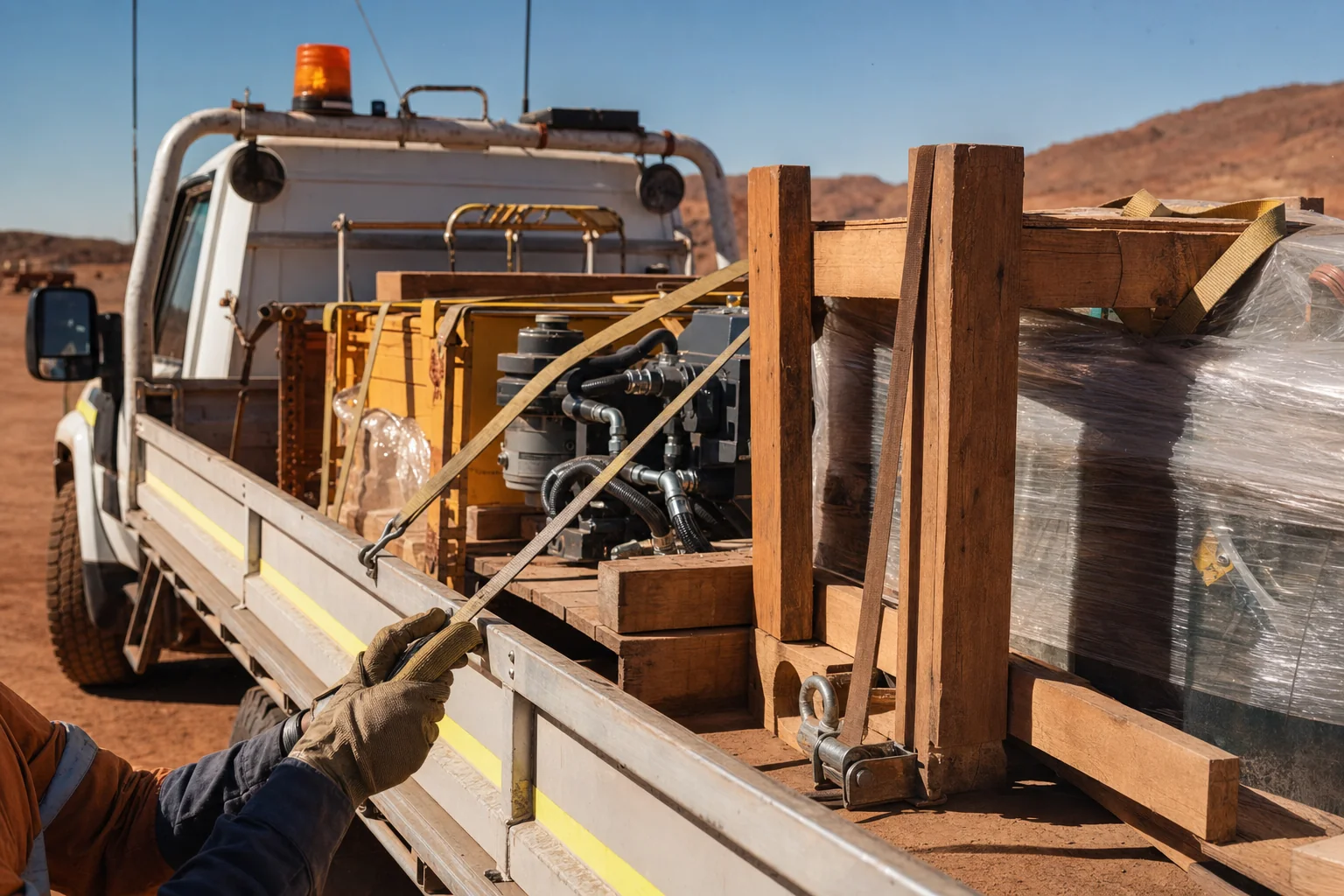
A crate with no flat bearing surface, no rated lifting points and no way to run a strap across it without crushing it is a restraint problem the driver inherits. The time to solve that is at the packing bench, where a timber cradle or a properly built crate costs minutes.
Give the Real Weight, Not the Order Weight
Understated weight is one of the most common problems on urgent runs. The figure on the purchase order is often the bare component, while the item that arrives at the dock includes a steel frame, a pallet, packing and preservation oil.
That difference decides which vehicle can legally carry it. Weigh the packed item and give dispatch that number, because a vehicle sent on an understated weight either has to leave freight behind or travel outside its limits.
- Weigh the item as packed, including pallet, crate, cradle and packaging
- Give the packed dimensions as well, since height and overhang can matter more than weight
- Flag anything with an uneven or top-heavy centre of gravity so it can be placed correctly on the tray
- Tell dispatch if the item cannot be laid down, tilted or stacked
- Say up front if the load includes anything classified as dangerous goods, before the vehicle is allocated
A WA Run and an Interstate Run Are Not Under the Same Law
Western Australia has not adopted the Heavy Vehicle National Law that applies across the eastern states. WA heavy vehicle operations are regulated under state legislation administered by Main Roads WA, which covers the same ground of mass, dimension, load restraint and fatigue.
For a Perth to Pilbara or Perth to Goldfields run, that state framework is the one that applies. The practical duties on a consignor are much the same either way, so this is not a reason to relax about a purely intrastate job.
It does matter on an interstate run. Freight leaving Perth for the eastern states crosses into national law jurisdiction partway through the journey, and the obligations that attach to your booking follow it across the border.
Check the vehicle class, not just the carrier
Heavy vehicle law turns on the vehicle's gross vehicle mass, so whether a specific run falls inside the heavy vehicle framework depends on the configuration sent. If your compliance team needs to know, ask dispatch which vehicle is being allocated at the time of booking rather than assuming.
What to Ask and Record Before You Book
Almost every chain of responsibility problem on urgent freight traces back to missing information rather than bad intent. The person booking knew something the carrier needed and did not pass it on, usually because the job was rushed.
- 1
Weigh and measure the freight as packed
Give dispatch the actual packed weight and dimensions, not the figure on the purchase order. This decides the vehicle and the restraint method.
- 2
State the real required-on-site time
Give the time the part is genuinely needed and ask the carrier to confirm it can be met inside legal driving hours before you commit to it internally.
- 3
Declare anything unusual about the load
Dangerous goods, an odd centre of gravity, an item that cannot be tilted, or packaging that cannot take a strap across the top.
- 4
Confirm who is loading and who restrains
Agree whether your dock crew loads and restrains or whether the driver does, so the responsibility is not assumed by both sides and done by neither.
- 5
Confirm access and receiving at the other end
Delivery point, gate requirements, contact name and shift. A driver held at a gate at the end of a long run is a fatigue problem as well as a delay.
- 6
Keep the booking record
The email or job sheet showing what you disclosed and what window was agreed is the evidence that you took reasonable steps. Keep it with the job.
None of this slows an urgent job down in any meaningful way. It is a handful of details passed on at the point of booking, and it is the difference between a run that is fast and a run that is only fast until something goes wrong.
Need a hotshot moving now?
Our dispatch team is on 24/7. Tell us what's stopped and we'll get it rolling.
Call (08) 6103 5089FAQs
It can. The duty attaches to what you influence rather than to what you are called on the invoice. If you set the delivery deadline, described the freight, packed it or loaded it, you are acting as a party in the chain regardless of the label on the transaction.
You can write the clause, but it does not transfer your duty. The obligation follows the influence you actually have over the transport task, so a contractual term does not remove responsibility for a deadline you set or a load your team packed.
The vehicle may arrive unable to legally carry the freight, which means either leaving part of it behind or a second run. Understating weight also creates a compliance exposure for you as consignor, so weigh the item as packed and pass on that figure.
It depends on the gross vehicle mass of the vehicle allocated, since the heavy vehicle framework is defined by vehicle mass rather than by the type of job. Ask dispatch which configuration is being sent if your compliance team needs to record it.
Give the time the part is genuinely needed on site and ask the carrier to confirm the realistic arrival window for that corridor first. If the window is immovable and a single driver cannot meet it legally, ask about a two-driver run rather than asking one driver to make up time.

Mr Hotshot
Perth-based hotshot transport built around time-critical mining and industrial freight across Western Australia - not general courier work.